
ODOC Latimer Release Routes
The Oklahoma Department of Corrections is a statewide prison and supervision system. It is not the Latimer County jail. A defendant sentenced in Latimer County may wait in the county detention center until ODOC receives the person. The county event is then a transfer. A later parole, discharge, or other release belongs to ODOC's sentence-administration record and may occur far from Latimer County.
A state prisoner can leave an institution on parole while remaining under conditional supervision. A person can also discharge after completing the controlling term. Probation may follow a court sentence without a prison admission. These states are not interchangeable. Read the exact label and history in the ODOC result, then match it to the judgment, Board action when relevant, and completed release document.
- Reception
- ODOC's intake of a person sentenced to state custody.
- Projected release date
- An estimate that can move as sentence and credit facts change.
- Parole
- Conditional release from prison during the unexpired term.
- Discharge
- The end of the custody or supervision component shown by ODOC.
Search ODOC Latimer Releases
ODOC Offender Lookup is the primary public route. Search by DOC number whenever possible because it is more precise than a name. If only a name is known, use the legal surname and given name, try documented variants, and compare the age, photograph, Latimer County case, conviction details, and incarceration history. Never select a record on a shared name alone.
- Open ODOC Offender Lookup and read the search notice.
- Enter the DOC number, or search the person's full legal name.
- Open the plausible record and compare its identifiers and Latimer County case.
- Read the current status, location, and incarceration history together.
- Record the exact terms shown rather than replacing them with a general “released” label.
- Use the case number and DOC number in any formal follow-up request.
A present institution or location supports current state custody. A community-supervision entry may support parole or probation. A historical or discharged record can remain after release. No result may mean the person never entered ODOC, the name differs, or a new transfer has not posted. It does not prove freedom.
ODOC Release Search Fields
ODOC public records commonly identify a person by name and DOC number and may show a photograph, descriptors, status or location, conviction and case information, and incarceration history. The visible fields vary by record. A public search result should be described as it appears, without promising that each file has an exact discharge date or a single standard release label.
| Field | Use in a Latimer release check |
|---|---|
| DOC number | Separates the person from namesakes and anchors requests |
| Photograph and descriptors | Help compare identity but do not prove current status |
| Status and location | Show the reported state placement or supervision state |
| Case and court county | Connect the result to the Latimer judgment |
| Incarceration history | Distinguishes a current term from an old admission |
| Projected release date | Shows an estimate only when the live record provides it |
Advanced conviction details can include date, court, case or CRF number, term codes, and statute information. Treat abbreviations carefully. ODOC warns that public data may not be complete and directs requesters to the department for formal documentation.
Request ODOC Release Proof
A completed ODOC event can be supported by records stronger than a pre-release estimate. OP-060212 identifies the Consolidated Record Card, Discharge Notice, Certificate of Release, Release Checkout Sheet, earned-credit reports, Final Disposition Report, and Termination Summary. Ask for the document that answers the exact question. Include the person's name, DOC number, case, and the event or date range.
- Use the ODOC Open Records form for releasable current or public material.
- Use the Closed Records form for an inactive file.
- Name the requested release, discharge, checkout, or final-disposition document.
- Ask ODOC to identify any authorization needed for confidential portions.
- Request a cost estimate and the nonexempt remainder if a part cannot be released.
ODOC policy posts a $0.25-per-page copy rate. Closed Records can be reached at 405-425-2691. Some incarceration or supervision material needs the subject's authorization, a court order, or another recognized basis. A request for a completed event is different from seeking a confidential exact future release appointment.
Phone: 405-425-2691
Legal Services and records forms
State records, not county-only booking files
ODOC Projected Versus Actual Release
The Oklahoma Pardon and Parole Board defines Projected Release Date, or PRD, as ODOC's estimate of when an offender will leave prison. Credits, programs, misconduct, new sentence facts, and placement can increase or decrease it. The Board does not calculate the PRD. ODOC also states that an inmate's exact release date is confidential without a recognized legitimate need and that a date supplied to the inmate remains tentative.
Read any public PRD as an estimate. It is not a pickup time, guarantee, or completed discharge. ODOC gives an inmate a monthly days-remaining calculation, which the inmate may choose to share. After release, request a Certificate of Release or Discharge Notice when formal proof is needed. The Latimer County projected release resource separates state credits, county-jail credits, and the statutory minimum-service rule.
ODOC Latimer Sentence Credits
State calculations start with the controlling judgments, sentence order and start, jail credit, and law in force for the offense. Under 57 O.S. § 138, ODOC uses class-level earned credits. The research identifies a current framework that includes no monthly credits in Class 1, 22 in Class 2, and different Class 3 and 4 rates depending on restricted-credit status. Achievement or program credits may also apply.
Credits can be lost through due process and restored under set criteria. Life and some other sentences do not accrue them in the usual way. Offenses listed in 21 O.S. § 13.1 have a minimum-service floor commonly called the 85% rule. That floor is not a promised release date. County-jail “five for four” credit under 57 O.S. § 65 is a separate rule and should not be inserted into an ODOC calculation.
Note: ODOC Sentence Administration, not a homemade calendar, is the departmental authority for a state release calculation.
ODOC Parole Release Records
A favorable parole event and a completed physical release are separate. The Oklahoma Pardon and Parole Board publishes monthly dockets and validated results. A docket shows that a person was scheduled for consideration. It does not show that the person left custody. Three favorable votes may be needed, and some violent-offense recommendations go to the Governor.
Even after favorable action, conditions, gubernatorial review where required, detainers, and ODOC processing can remain. Confirm the final status in the ODOC record and, when appropriate, through VINE. Once parole begins, ODOC supervision continues for the unexpired term. The assigned office must be confirmed from the current state record because the current and older Latimer County office sources do not fully agree.
ODOC Discharged Record Access
ODOC keeps an offender file active through incarceration or supervision. OP-060212 says the file becomes inactive on discharge and that inactive records are retained indefinitely through Closed Records, digital storage, or microfilm. A parole or probation field file should move to the supervising region after processing, while a discharged file proceeds toward Closed Records. This difference explains why the right contact changes after a status change.
Former offenders can ask Closed Records to review their information. The policy states that records should be available for review within 30 days. Errors originating with another reporting agency go back to that agency, while an ODOC-originated issue goes to the offender-records coordinator. The review path corrects reported facts; it cannot override a valid Latimer County judgment.
Latimer Transfer Into ODOC
The Latimer County sheriff's stated duties include transport to ODOC. A defendant may remain in the county jail while awaiting state reception. When that transport occurs, the county release record should identify ODOC as the destination. The person's absence from local custody therefore marks a handoff, not a state discharge.
Pair the sheriff's transfer entry with the Latimer County judgment and ODOC admission history. Allow for data-entry lag. If a new ODOC record is not visible, ask the sheriff who took custody and use the case number in an ODOC inquiry. This three-record chain avoids calling a state reception a release into the community.
| Stage | Record owner | Meaning |
|---|---|---|
| Latimer sentence and commitment | District Court | Legal authority for state custody |
| County departure to ODOC | Latimer County Sheriff | Physical transfer from the jail |
| State reception and later status | ODOC | State incarceration, supervision, parole, or discharge |
ODOC Latimer Lookup Screen
The official state lookup presents the name and DOC-number route used for a Latimer County state case. Open ODOC Offender Lookup at its source before relying on the captured interface.
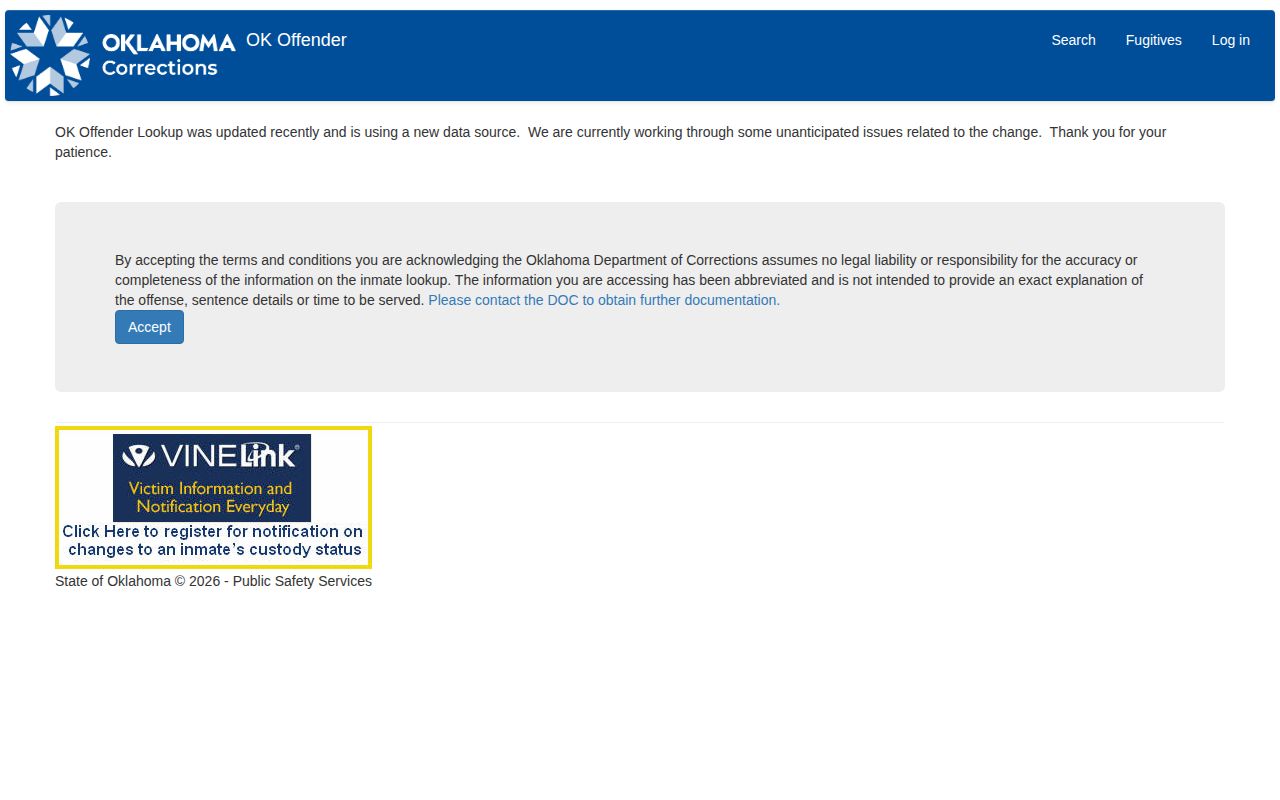
The image shows the search entry point, not a person's release. A matching detail record still needs careful identity review and, for formal confirmation, the relevant ODOC release or discharge document.